

Overvalued, Not Overheated: Brisbane’s Property Paradox

Brisbane is over-valued, but the bubble is not going to burst before the Olympics, according to new long-range data analysis.
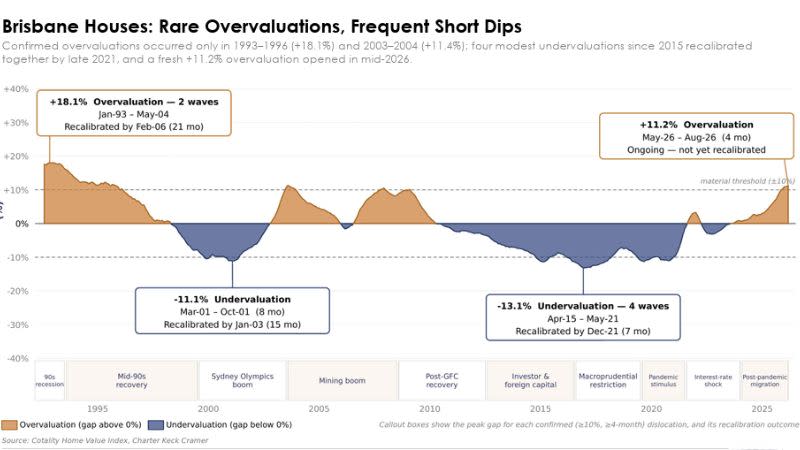
Brisbane’s runaway property growth over the past five years has pushed the city into overvalued territory for just the third time in four decades.
But the market has further to run before the real reckoning arrives, according to Charter Keck Cramer national executive director Richard Temlett.
Temlett’s research, which benchmarks each capital city’s house and unit prices against the other four every month since the mid-1980s, found Brisbane houses were 11.2 per cent overvalued as of May this year—its first sustained overvaluation since 2004.
But Temlett said the figure needs context most commentators skip.
“People keep forgetting that the market is cyclical,” he said.
“Probably half of the growth Brisbane’s had is just to bring it back into balance. It’s only the next half that means it’s overvalued — and even then, it’s not overvalued in a worrying sense when you compare it to what’s happened in Melbourne and Sydney historically.”
Those two cities have each spent extended stretches 30 to 40 per cent overvalued against their peers.
Melbourne houses peaked at 38.1 per cent overvalued between 2015 and 2023, the largest gap in the 40-year dataset. Brisbane, by contrast, spent much of the 2010s and early 2020s undervalued, particularly in the apartment market, a legacy Temlett traces back to oversupply.
The apartment glut that took 11 years to unwind
The report’s starkest Brisbane finding is in units, not houses: an undervaluation that opened in August 2012 and didn’t fully recalibrate until February 2025—137 months, the longest dislocation of any city or property type in the study.
Temlett puts that down to the wave of apartment construction that hit Brisbane in the years before the pandemic.
“There was an oversupply of apartments in Brisbane,” he said.
“That additional supply is good for the housing market, but compared to where population growth was, it was overbuilt. There was still an undersupply of houses, so house prices either increased or didn’t drop as much, whereas there were just too many apartments built at that time.”
That overhang has now been “well and truly absorbed,” Temlett said, to the point Brisbane is grappling with one of the tightest rental markets in the country.
Olympic-sized hangover
Temlett draws a direct parallel between Brisbane’s current trajectory and Sydney’s run-up to the 2000 Olympics, which the report shows produced a sharp overvaluation followed by a multi-year correction.
He expects Brisbane to follow the same pattern: strong growth into 2032, underpinned by Olympics-linked infrastructure spending and rate cuts he anticipates within 12 to 18 months, followed by a natural pullback once the Games are over.
“It’s almost like a hangover, and it’s actually quite natural,” he said.
“I don’t believe [a correction] is going to occur to the extent of a crash. Looking at all the fundamentals, population growth, jobs, incomes, I anticipate Brisbane will still have a really strong run up to the Olympics, and then after the Olympics it’s highly likely there will be a correction.”
For investors, that’s not a reason to sit out, he argues.
“I certainly wouldn’t be turning away from Brisbane, especially as an investor,” he says.
“As a developer, it’ll be difficult [with] the builder shortage. But if government gets skilled workers into the industry, I don’t see it correcting to the point of falling off a cliff.”
Adelaide’s turn to worry
If Brisbane is the “closing the gap” story, Temlett flags Adelaide as the market to watch for the opposite reason.
The report shows Adelaide units in a record 35.5 per cent overvaluation as of August 2026—the largest and longest-running in the market’s history, with no recalibration apparent in the data.
Temlett says the city’s smaller economy makes it more exposed than the eastern capitals to a pandemic-era migration surge it wasn’t built to absorb.
“Adelaide is overvalued, and it is already correcting,” he says.
“It doesn’t typically have the boom-and-bust cycles of the bigger cities, or the huge economy, even though that’s changing. As a result of the lockdowns, people went straight to Adelaide and drove significant price growth that it just couldn’t really handle.”
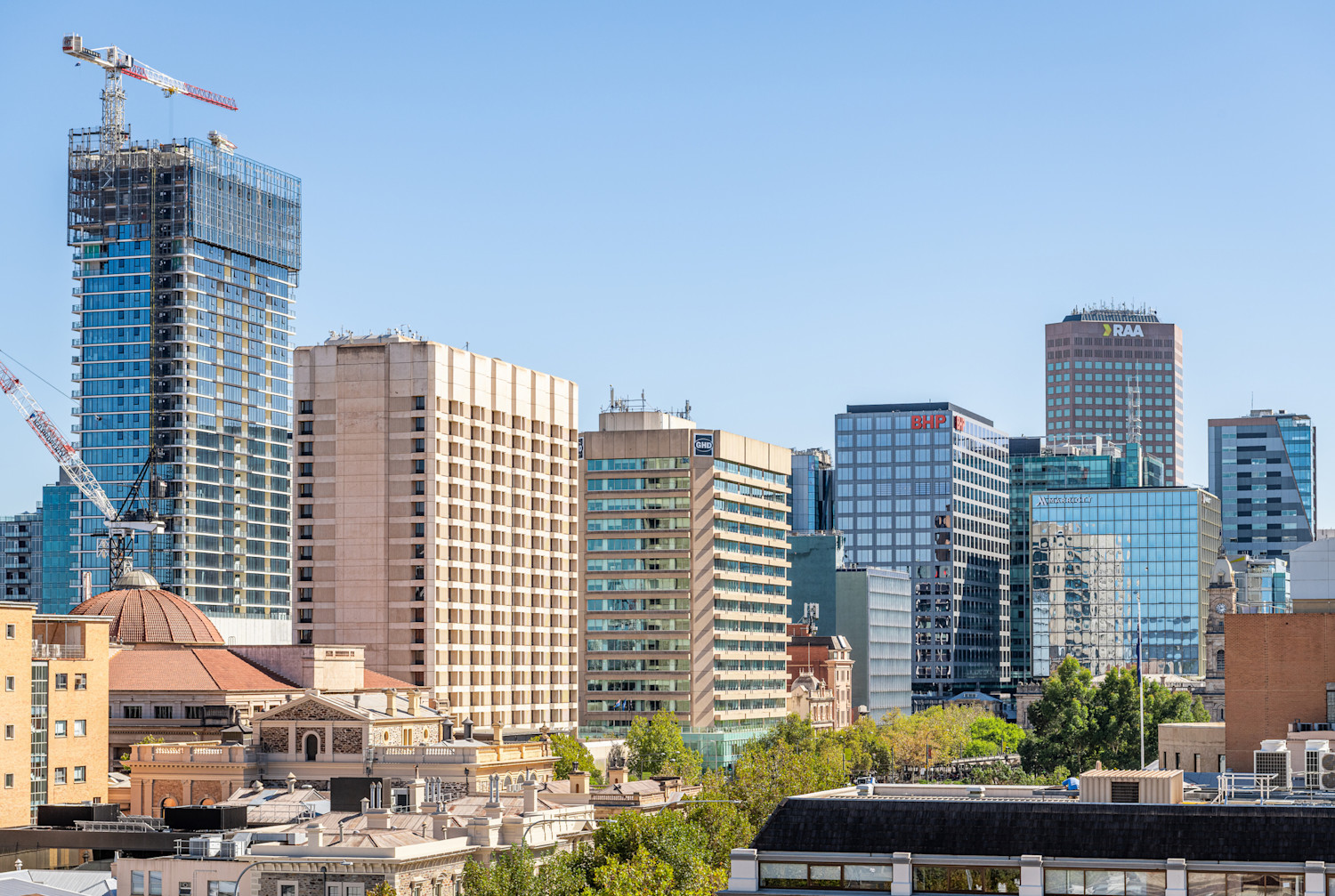
He says new-build pricing in Adelaide has, in some cases, converged with Melbourne.
Migration is swinging back to Melbourne
Temlett links the shift directly to interstate migration data, which he says is now reverting to pre-pandemic patterns.
“Right now, migration is following its normalcy,” he said. “Melbourne is the beneficiary; for the first time in about five years, it’s had positive interstate migration.
“I suspect that’s going to occur again, because Adelaide is now more expensive than Melbourne.”
That reversal, he argued, is also why Melbourne’s deeply undervalued apartment market — the deepest unit undervaluation in the 40-year dataset, at -26.5 per cent — is worth watching.
“The established market needs to move back into balance for new projects to be viable. But Melbourne is a huge counter-cyclical player.”
SEQ still a good bet
Temlett says if he was a developer or an investor in South-East Queensland he would stay the course.
“Queensland has come off a very low base — it was significantly undervalued. The market is cyclical, and this has already happened over the last 40 years. If I was an investor, I’d still be looking at Brisbane.”
*This post was originally published on (https://www.theurbandeveloper.com/articles/overvalued-not-overheated-brisbane-s-property-paradox?utm_source=piano&utm_medium=email&utm_campaign=weeklybriefing&pnespid=o.XLn9RN8aTJ4bLs_ROn7OQY5wsP_3F_xVQpE1ZvqkeVsc9aG.blFF_p5EaMwcd9j5d9x5bkIg)
You might also be interested in

Sep 30, 2026
‘This is How Cities Implode’: Qld’s Affordability Time Bomb
Queensland’s affordability train has pulled out of the station. And thousands of people are still crowding the platform—among them the growing ranks of the “working homeless” including key workers
Sep 9, 2026
Ex-Olympic Village Site to Supercharge Brisbane’s Inner-North
The banks of the Brisbane River once destined to house the world’s elite athletes during the 2032 Olympics are back on the development starting blocks in a move predicted to supercharge the city’s i